UAV Drone Production Line China
What is UAV Pulse Assembly Line and how to find the manufacturer at China?
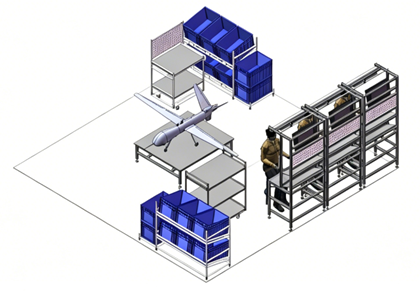
UAV Pulse Assembly Line
Definition in one sentence
A beat-based intermittent assembly model in the aviation industry. Its core logic: workstations and workers stay stationary, while the UAV airframe (mounted on AGVs or guided tooling) “pulses” forward from station to station at a fixed takt time. Each station completes a predefined set of processes. Once all stations are finished, the complete aircraft rolls off the line.
Difference from the traditional model: Traditional assembly = airframe fixed in place; teams of workers move around the aircraft (workers move, airframe stays). Pulse line = workers stay, airframe moves.
Operating Principle
- The production line is split into independent stations. Each station handles only a small, standardized scope of work.
Example: The CH UAV pulse line has 6 stations: sub-frame pre-assembly → cable routing → avionics installation → fuel tank assembly → power system fitting → exterior & landing gear installation, followed by full aircraft testing and final dispatch.
- Each station operates to a predefined takt time. Once all tasks at the current station pass inspection, AGVs or guided tooling transfer the complete UAV / sub-assembly to the next station. This intermittent movement is called one pulse.
- Multiple UAVs are assembled in parallel at different stations along the line, instead of building one aircraft fully before starting the next. After each pulse cycle, a finished UAV exits at the end of the line.
- Supported by MES, electronic SOPs, pull-type material delivery and digital quality traceability to enable workstation error-proofing and real-time progress visibility.
Key Benefits (critical for mass export & volume production of UAVs)
- Greatly shortened lead time & higher throughput Traditional final assembly for large and medium fixed-wing UAVs may take months. Pulse lines cut this down to several days (CH series: less than one week per unit). Heavy-lift UAVs can reach one unit within a few hours.
- Higher consistency of assembly quality Fixed station workflows and dedicated tooling reduce variability caused by different operators, suitable for bulk export orders and mass swarm UAV production.
- Flexible mixed-model production The same line can quickly switch between multirotor, fixed-wing and VTOL UAV variants, supporting multi-model co-production and accommodating fluctuating order volumes — a highly valued feature for B2B export manufacturers.
- Better utilization of floor space & labour Workers spend less time transporting tools and components. Materials are delivered point-to-point to stations, cutting on-site waste. FAT factory acceptance tests can be embedded directly into the line workflow.
Limitations (to consider in engineering planning)
- High upfront capital investment: requires dedicated flexible tooling, AGVs, guide rails and digital systems; line layout design takes a long time.
- Station balancing is the bottleneck: work hours across stations must be well balanced. Frequent rework or hold-ups at any single station will slow down the whole line (pulse stoppage).
- Best suited for medium-to-high volume mass production. Not economical for low-volume, custom special UAVs, which normally use conventional fixed-station assembly.
Typical Domestic Cases
- CH (Caihong) series pulse final assembly lines (Taizhou, Gu’an)
- Wing Loong UAV pulse final assembly line
- Harbin United Aircraft heavy-lift large UAV pulse line
- Small pulse assembly lines are widely adopted for multirotor, consumer-grade UAVs and loitering munition swarms.